
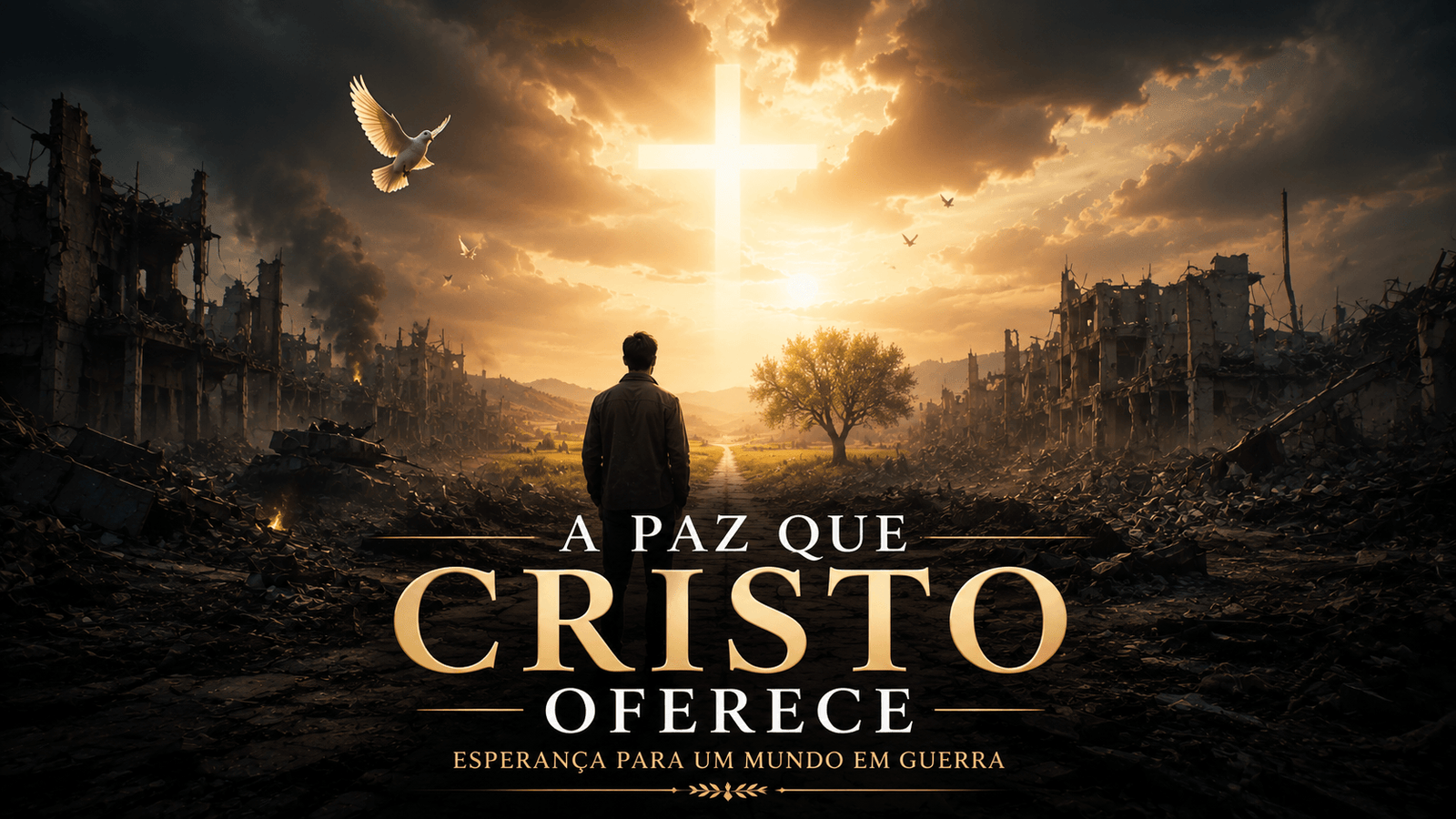
I – Introduction: War, Violence, and the Christian: What Does the Bible Say?
The images that reach us daily are disturbing: wars, massacres, cities reduced to rubble, children fleeing conflicts they did not start and cannot understand. Violence seems to be written into the very fabric of human history, from the first fratricide recorded in Genesis to the armed conflicts that fill today’s news. And in the face of all this, a question inevitably arises in the heart of anyone who believes: What does God say about all this? Where is the Prince of Peace in a world that seems increasingly given over to war?
This article does not intend to offer simplistic political answers or take partisan sides in specific conflicts. The purpose here is deeper and more urgent: to look at what the Bible — God’s revealed Word — teaches about the origin of violence, about the peace that Christ offers, and about how the Christian is called to live and respond in a world marked by war. Because the Christian faith is not an escape from reality; it is a light that illuminates reality, even in its darkest aspects.

1 – Where Does Violence Come From? The Biblical Diagnosis
To understand war, we need to go back further than any specific historical conflict. The Bible presents a radical diagnosis of violence: its root is in the human heart separated from God.
The first act of violence recorded in Scripture is the murder of Abel by his brother Cain, in Genesis 4. What motivated it? Jealousy, resentment, pride — the internal states of a heart that had turned away from God. Before the first blow fell, God warned Cain: “Why are you angry? Why is your face downcast? If you do what is right, will you not be accepted? But if you do not do what is right, sin is crouching at your door; it desires to have you, but you must rule over it” (Genesis 4:6-7, NIV). The warning was ignored, and the consequences marked all of human history.
Jesus, centuries later, identified the same source. When questioned by the Pharisees about what truly defiles a person, He responded with a description that cuts to the heart: “For out of the heart come evil thoughts — murder, adultery, sexual immorality, theft, false testimony, slander” (Matthew 15:19, NIV). War, in all its scales — from the domestic conflict between spouses to the global conflict between nations — flows from this same corrupt source: the human heart marked by sin.
James, in his epistle, makes this connection even more explicit: “What causes fights and quarrels among you? Don’t they come from your desires that battle within you? You desire but do not have, so you kill. You covet but you cannot get what you want, so you quarrel and fight” (James 4:1-2, NIV). This is an uncomfortable diagnosis because it points the finger inward, not outward. We prefer to believe that violence is always someone else’s problem, another nation’s, another group’s. James says: the battlefield begins in the human heart.
This does not mean, however, that all wars are morally equivalent or that there are no legitimate differences between aggressor and defender, between oppressor and oppressed. The Bible also recognizes the role of governing authorities in maintaining order and protecting the innocent (Romans 13:1-4). But understanding the root of violence — the fallen human heart — is essential so that we do not seek superficial solutions for a deep problem.

2 – What Did Jesus Teach About Peace and Violence?
Jesus grew up in a Palestine occupied by the Roman Empire, in a political and social context of constant tension, rebellions, and violent repression. He was not a distant philosopher speaking in an abstract ivory tower; He spoke to people who knew very well what it meant to live under the threat of violence and oppression. And His teaching on peace and violence was, in every sense of the word, revolutionary.
From the beginning, God’s intention for creation was not war. Isaiah prophesied that nations would “beat their swords into plowshares and their spears into pruning hooks” (Isaiah 2:4, NIV) — a powerful image of the peace God desires for His creation. War, therefore, is not God’s Plan A; it is a reality He permits within His sovereignty, but which He promises to overcome definitively.
Jesus brought a radically new perspective to the theme of violence. In His famous Sermon on the Mount, He challenged the patterns of retribution that govern human conflicts: “You have heard that it was said, ‘Eye for eye, and tooth for tooth.’ But I tell you, do not resist an evil person. If anyone slaps you on the right cheek, turn to them the other cheek also” (Matthew 5:38-39, NIV). This teaching is not political naivety; it is an ethical revolution that challenges the logic of escalating violence, where each act of revenge generates another, in an endless cycle of destruction. Jesus points to a radically different path — one that is only possible through the interior transformation the Holy Spirit works.
Jesus also proclaimed one of the most challenging and most necessary Beatitudes of our time: “Blessed are the peacemakers, for they will be called children of God” (Matthew 5:9, NIV). Peacemakers — those who actively work for reconciliation, who seek peace even in conflict situations, who refuse the logic of hatred and retribution — are called children of God. This is an identity that goes far beyond a political stance; it is a spiritual vocation, a reflection of the character of the God who reconciled humanity to Himself through Christ.

3 – Jesus Christ: The Prince of Peace in a World at War
More than 700 years before the birth of Jesus, the prophet Isaiah proclaimed one of the most extraordinary prophecies in all of history: “For to us a child is born, to us a son is given, and the government will be on his shoulders. And he will be called Wonderful Counselor, Mighty God, Everlasting Father, Prince of Peace” (Isaiah 9:6, NIV). In a world that lived under the constant shadow of wars, empires, and oppression, God announced the coming of a Prince whose nature and central mission would be peace. Not a temporary peace conquered by force of arms, but an eternal peace rooted in reconciliation between God and humanity.
When Jesus was born in Bethlehem, the angels proclaimed to the world: “Glory to God in the highest heaven, and on earth peace to those on whom his favor rests” (Luke 2:14, NIV). This was not a naive promise that the world would immediately stop having conflicts; it was the proclamation that the Prince of Peace had arrived, and that through Him, God was inaugurating a new order of existence — one where peace with God would be possible, and where reconciliation between human beings would become a reality for those transformed by His love.
Jesus’ mission was neither military nor political, though many of His contemporaries expected exactly that. They wanted a Messiah who would drive out the Romans by force, who would establish an earthly kingdom of power. Jesus deliberately frustrated these expectations, because the problem He came to solve was far deeper than Roman occupation: it was the rupture between God and humanity caused by sin — the ultimate root of all violence, hatred, and destruction. Paul describes this mission with language that is simultaneously theological and deeply personal: “For he himself is our peace” (Ephesians 2:14, NIV). Not merely a messenger of peace, not merely a teacher of peace — He is the peace. In His person, the chasm between God and humanity was bridged, and the foundation for all genuine reconciliation was established.
The cross, which in the world’s eyes appeared to be a symbol of defeat and violence, is paradoxically the greatest act of peace in history. There, Jesus absorbed in Himself the penalty of human sin, satisfied the just wrath of God, and opened the way for men and women of every nation, race, and tongue to be reconciled to the Father and, consequently, to one another. As Paul writes: “For God was pleased to have all his fullness dwell in him, and through him to reconcile to himself all things, whether things on earth or things in heaven, by making peace through his blood, shed on the cross” (Colossians 1:19-20, NIV).

4 – The Peace Christ Offers: Unlike Anything the World Knows
One of Jesus’ most remarkable statements is found in John 14:27, where He says to His disciples, on the eve of His crucifixion: “Peace I leave with you; my peace I give you. I do not give to you as the world gives. Do not let your hearts be troubled and do not be afraid” (NIV). The phrase “I do not give to you as the world gives” is of capital importance. It reveals that there is a fundamental difference between the peace the world offers and the peace Jesus offers. Understanding this difference is essential to comprehending the unique proposal of the Gospel in the face of the reality of violence.
The peace the world offers is, in essence, a peace based on external circumstances. The world promises peace when there is no war, when the economy is stable, when threats have been eliminated, when relationships are without conflict. It is a conditional, fragile peace, constantly threatened by forces beyond our control. One political crisis, one unexpected piece of news, one threat of conflict is enough for this peace to dissolve like morning mist. It is the peace of the absence of war, not the peace of the presence of God — and there is an abysmal difference between the two.
The peace Jesus offers is of a radically different nature. It does not depend on external circumstances, but is born from an inner reality: reconciliation with God. Paul describes it with words that defy human comprehension: “And the peace of God, which transcends all understanding, will guard your hearts and your minds in Christ Jesus” (Philippians 4:7, NIV). A peace that transcends all understanding is a peace that cannot be explained rationally, because it exists independently of the circumstances that would normally deny it. It is the peace Paul experienced when he wrote that letter from inside a Roman prison. It is the peace of the martyrs who sang on their way to death. It is the peace the disciples experienced after Jesus’ resurrection, when He appeared in their midst and said: “Peace be with you!” (John 20:19, NIV) — even as they were locked away for fear, surrounded by uncertainty and danger.
This peace has a vertical dimension and a horizontal one. The vertical dimension is peace with God: “Therefore, since we have been justified through faith, we have peace with God through our Lord Jesus Christ” (Romans 5:1, NIV). Before Christ, the human being was in a state of enmity with God because of sin. Through the redemptive work of Jesus, that enmity was removed and replaced by a peace that defines our entire existence. The horizontal dimension is peace with others: when two enemies are reconciled to God, they discover a foundation for reconciling with each other. Paul describes this impressively when speaking of Jews and Gentiles — who were historical enemies — being united in Christ: “For he himself is our peace, who has made the two groups one and has destroyed the barrier, the dividing wall of hostility” (Ephesians 2:14, NIV).

5 – The Gospel as an Agent of Transformation: When Christ’s Love Changes Violent Realities
One of the most powerful demonstrations of the Gospel’s transforming capacity is the impact it has on lives marked by violence. Throughout Church history, and still today, there are countless accounts of people who lived in the cycle of violence — whether as victims or as perpetrators — and who were radically transformed by an encounter with Jesus Christ. Not by the force of an ideology or moral discipline, but by the real experience of being loved and forgiven by God, which liberates the human being from the inside out.
The apostle Paul himself is an eloquent biblical example of this transformation. Before his encounter with Christ on the road to Damascus, Saul of Tarsus was a violent persecutor of Christians, who approved of the stoning of Stephen and went from house to house dragging men and women to prison (Acts 8:1-3). He describes himself as “the worst of sinners” (1 Timothy 1:15, NIV). But after the encounter with the Risen One, this same man became the greatest missionary in Christian history, dedicating his life to proclaiming the peace he had found, suffering persecution, imprisonment, and finally martyrdom out of love for Christ and for others. What worked this transformation was not human effort, but the irresistible grace of God.
Today, Christian organizations work in conflict zones around the world — in countries devastated by civil wars in Africa, in communities overtaken by organized crime in Brazil, in territories marked by ethnic hatred in the Middle East — bringing not only humanitarian aid, but the Gospel of reconciliation. And the accounts of transformation are real: former combatants becoming peacemakers, killers asking forgiveness from the families of their victims, entire communities finding in the Christian faith a foundation for rebuilding what violence destroyed. This does not mean the Gospel solves all political and social problems immediately; it means it acts at the root — the human heart — producing changes that no legislation or peace agreement can produce alone.
Paul writes about this transforming reality: “Therefore, if anyone is in Christ, the new creation has come: The old has gone, the new is here!” (2 Corinthians 5:17, NIV). The “new” that emerges includes new values, new motivations, a new way of seeing others — including the enemy. Jesus calls His followers to the most radical challenge there is: “Love your enemies and pray for those who persecute you” (Matthew 5:44, NIV). This commandment, impossible for unregenerate human nature, becomes a real possibility for those indwelt by the Holy Spirit who understand that they too were once enemies of God and were loved and forgiven.

6 – Facing Violence: How the Christian Should Respond
In a violent world, the follower of Christ is called to a posture that is neither naive nor passive, but deeply rooted in the hope and love of the Gospel. The Bible offers concrete principles for navigating the reality of violence without being consumed by it, and without abandoning the hope we have in Christ.
The first principle is genuine mourning. Jesus said that those who mourn are blessed (Matthew 5:4), and there is a time to weep in the face of violence and suffering. Lamenting the victims, feeling the pain of the destruction caused by war, being indignant at injustice — this is not weakness; it is a genuine human and Christian response. The Psalms are filled with honest laments in the face of violence and oppression, as in Psalm 22, where the psalmist cries out: “My God, my God, why have you forsaken me? Why are you so far from saving me?” The Bible gives us permission to mourn, because honest lament is the beginning of the cry for redemption.
The second principle is prayer. Paul exhorts us: “I urge, then, first of all, that petitions, prayers, intercession and thanksgiving be made for all people — for kings and all those in authority, that we may live peaceful and quiet lives in all godliness and holiness” (1 Timothy 2:1-2, NIV). Praying for leaders, for peoples at war, for victims and even for the perpetrators of violence is not an escape from reality; it is a real and powerful spiritual action, connecting our human powerlessness to the sovereign power of God who acts in history.
The third principle is the active pursuit of peace and justice. The Christian is not called to be indifferent to the suffering of others, but to be an agent of peace and reconciliation in his or her context. This can manifest in very different ways: supporting humanitarian organizations, defending victims of violence, mediating conflicts in close relationships, working for reconciliation in divided communities. Paul is categorical: “If it is possible, as far as it depends on you, live at peace with everyone” (Romans 12:18, NIV). And Peter adds: “Turn from evil and do good; seek peace and pursue it” (1 Peter 3:11, NIV). The pursuit of peace is not optional for the Christian; it is part of his or her vocation.
The fourth principle is non-retaliation. In a world operating by the logic of “an eye for an eye,” the Christian is called to resist the temptation of revenge: “Do not repay anyone evil for evil. Be careful to do what is right in the eyes of everyone. If it is possible, as far as it depends on you, live at peace with everyone. Do not take revenge, my dear friends, but leave room for God’s wrath, for it is written: ‘It is mine to avenge; I will repay,’ says the Lord” (Romans 12:17-19, NIV). This does not mean accepting oppression passively; it means trusting that God is the righteous judge and that true justice is in His hands — which frees us from the destructive cycle of retaliation.

7 – The Ultimate Hope: A World Without War
The Christian perspective on violence and war does not end with the diagnosis of the problem or with present-day response strategies. It points to a horizon that transforms everything: God’s promise of a completely renewed world, where war will exist no more.
The prophet Isaiah glimpsed this future with a beauty that still moves us profoundly today: “In the last days the mountain of the Lord’s temple will be established as the highest of the mountains; it will be exalted above the hills, and all nations will stream to it. […] He will judge between the nations and will settle disputes for many peoples. They will beat their swords into plowshares and their spears into pruning hooks. Nation will not take up sword against nation, nor will they train for war anymore” (Isaiah 2:2, 4, NIV). This vision of swords beaten into plowshares is one of the most powerful images in all human literature — a world where the instruments of destruction are transformed into instruments of life and sustenance.
The book of Revelation, which many associate only with catastrophes, is in fact a book of hope for those who suffer under violence and oppression. Its central message is that Christ, the Lamb of God, has won — and that His victory is the guarantee of history’s final destiny. The final vision of the book is of a new creation: “‘He will wipe every tear from their eyes. There will be no more death’ or mourning or crying or pain, for the old order of things has passed away” (Revelation 21:4, NIV). In a world where wars produce countless tears, where violence generates unutterable grief and pain, this promise is not escapism; it is an anchor of hope that enables us to keep walking amid present suffering without being swallowed up by it.
This hope is not passive; it transforms us in the present. As Paul writes: “Therefore, my dear brothers and sisters, stand firm. Let nothing move you. Always give yourselves fully to the work of the Lord, because you know that your labor in the Lord is not in vain” (1 Corinthians 15:58, NIV). Because we know where history is heading, because we know the Prince of Peace will reign definitively, we are motivated to work now for peace, reconciliation, and justice, knowing that every act of love and every gesture of reconciliation is a foretaste of the Kingdom to come.

Conclusion: Finding the Peace of Christ in a World at War
Violence and war are realities that have weighed upon humanity for millennia. The Bible does not flee from this reality; it confronts it with honesty, compassion, and depth, pointing to the root of the problem — the human heart separated from God — and to the only true solution: reconciliation with the Father through Jesus Christ.
Jesus did not come merely as an example of nonviolence, nor as the leader of a pacifist movement. He came as the Prince of Peace — the One who, by dying on the cross and rising on the third day, destroyed the deepest foundations of all hostility and inaugurated a new order of existence. He offers a peace the world does not know and cannot give — a peace born of reconciliation with God, that dwells in the believer’s heart regardless of external circumstances, and that expresses itself in reconciliation with others, in forgiveness, in service, and in the active pursuit of peace wherever we are.
If you live in a context of violence — whether physical, relational, or internal — Jesus’ invitation remains: “Come to me, all you who are weary and burdened, and I will give you rest” (Matthew 11:28, NIV). He does not promise that the world around you will immediately become peaceful. But He promises something that goes beyond that: an inner peace, a certainty, a presence that does not abandon you in the midst of the storm. And more: He promises a future where the storm will have ended for good — where swords will be plowshares, where every tear will be wiped away, where war will exist no more.
Until that day comes, we are called to be, each of us in our place, reflections of the Prince of Peace — peacemakers who, in being called children of God, live and proclaim the peace Christ conquered. Not a naive peace that closes its eyes to evil, but the courageous peace that faces evil with love, that forgives where it would be easier to hate, that reconciles where it would be simpler to divide, and that waits with certainty for the day when the One who said “I am your peace” will come to establish His Kingdom of justice and peace forever.
“May God himself, the God of peace, sanctify you through and through” (1 Thessalonians 5:23, NIV).