
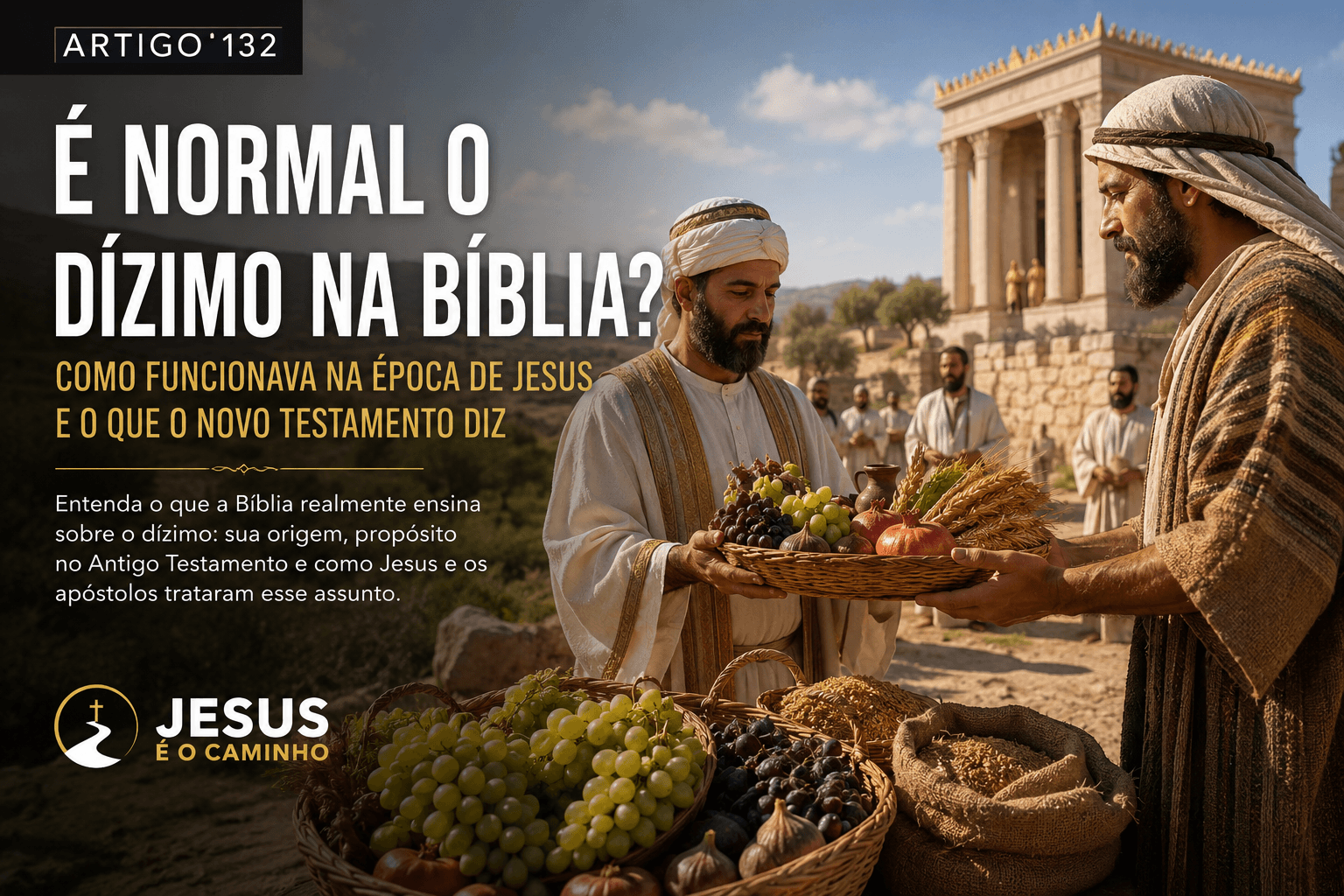
Introduction
Few subjects generate as much debate in Christian churches as tithing.
Some people argue that every Christian should give exactly 10% of their income. Others understand that the tithe was part of the Law given to Israel and that, in the New Testament, the principle becomes voluntary and generous giving. Still others tithe simply because that is what they were taught from the beginning of their Christian walk.
But before asking “should a Christian tithe?”, there is an earlier question that needs to be answered:
What, in fact, was the tithe in the Bible?
How did it work in Israel? Was the tithe always money? Was there only one 10% contribution? What did Malachi 3.10 mean? And when Jesus spoke about tithing, what system was in operation?
These questions are important because anyone who wants to practice biblical tithing today must first understand what the Bible itself calls a tithe.
This article is not intended to pressure anyone to start or stop tithing. The goal is to examine the main passages of Scripture, understand the context in which they appear, and then allow the reader to reflect with greater information and awareness before God.
Knowing only part of the story can produce a very different conclusion from the one that emerges when we see the whole picture.
In this article you will understand
The starting point is simple: before deciding how a biblical practice should be applied today, we need to understand what it meant within the biblical story itself.

Where does the tithe first appear in the Bible?
The first biblical episode in which the giving of a tenth appears takes place before the Law of Moses.
In Genesis 14, Abraham returns from a battle and meets Melchizedek, king of Salem and priest of God Most High.
After receiving Melchizedek's blessing, Abraham gives him a tenth.
This detail is important because, at that time, the Law of Moses had not yet been given.
The Levitical system later established in Israel did not yet exist, nor was there a national law requiring all the people to give a tithe.
Hebrews 7 returns to this episode and clarifies that Abraham gave a tenth of the spoils obtained in that context.
Abraham and Melchizedek
Abraham gives a tenth of the spoils after the battle. The episode shows that this practice existed before the Law of Moses.
Jacob and his vow
Jacob promises to give God a tenth of what he would receive. Again, the episode takes place before the legislation given to Israel.
It is therefore correct to say that the tithe appears in the Bible before the Law of Moses.
But a second question still needs to be asked:
do these episodes present a universal law requiring everyone to give 10%?
The text of Genesis 14 does not present such a command.
It records what Abraham did in that specific episode.
Jacob also speaks of giving a tenth
Another text from before the Law appears in Genesis 28.20-22.
After his experience at Bethel, Jacob makes a vow before God and declares that he would give a tenth of whatever God gave him.
Once again, we have a reference to a tenth before the Law of Moses.
However, the context is that of a personal vow made by Jacob.
The text does not present this declaration as legislation given at that moment to every family or to all future followers of God.
This does not make the episodes involving Abraham and Jacob unimportant.
On the contrary: they show that the idea of giving a tenth was already known before Israel's religious organization.
The important caution is not to make the text say more than it actually says.
The fact that the tithe appears before the Law of Moses is biblically true. But that fact, by itself, does not demonstrate that there is a universal command requiring every Christian to give exactly 10% of their income. Other biblical arguments would be needed to reach that conclusion.
Therefore, after observing the references that predate the Law, we need to move to the point at which the tithe becomes part of a clearly established system for Israel.
How did the tithe function under the Law of Moses?

It is in the Law of Moses that the tithe begins to appear within a clearly established system for the people of Israel.
In that context, however, it cannot simply be reduced to the modern idea of “giving 10% of one's salary every month.”
The biblical passages themselves show a broader picture.
Leviticus 27.30-33; Numbers 18.21-32; Deuteronomy 12; Deuteronomy 14.22-29; Deuteronomy 26.12-15.
When these texts are considered together, we see that the tithe was related to different aspects of Israel's life.
The Levites
Part of the system served to support the Levites, who performed religious functions and did not receive a territorial inheritance like the other tribes.
Celebrating before God
Deuteronomy describes a tenth connected with a meal and celebration before the Lord at the place chosen for worship.
The vulnerable
There is also a provision intended for the Levite, the foreigner, the orphan, and the widow, showing that care for vulnerable people was part of this system.
The tithe intended for the Levites
In Numbers 18.21-32, the Levites receive Israel's tithes as part of their support.
This was related to the way the tribes had been organized.
The Levites did not receive a large territorial allotment like the other tribes.
Their service was connected with worship and Israel's religious responsibilities.
The text itself also shows that the Levites were to set aside a portion of what they received.
Therefore, in this case, the tithe was directly connected to maintaining a religious structure specific to Israel's covenant.

A tenth was also connected with celebration
In Deuteronomy 14.22-27, we find an instruction that surprises some modern readers.
The tenth appears in connection with a meal before God.
The people were to take part of their produce to the place chosen by the Lord and participate in that celebration.
If the distance was too great to transport the produce, the text allowed them to convert it into money.
But that money does not appear simply as a permanent replacement of the agricultural tithe with a financial contribution.
It was taken to the place and used to buy what would be consumed in the celebration before God.
Thus, the money functioned there as a means of making transportation easier.
A provision for those in need
Deuteronomy also presents a provision connected with the third year.
In Deuteronomy 14.28-29 and 26.12-15, the Levite, the foreigner, the orphan, and the widow appear as beneficiaries.
In Jewish tradition, this system was organized within the seven-year cycle, with a contribution for the poor in certain years, traditionally understood as the third and the sixth.
This element shows that the biblical tithe was also related to communal responsibility and care for the vulnerable.
There are different ways of explaining the relationship between the texts in Numbers and Deuteronomy. For that reason, it is better to avoid the claim that the Bible simply established “three independent 10% taxes” without acknowledging that there is debate about how these provisions related to one another.
This caution is important because some modern presentations add together all the references and produce an exact annual percentage as though no interpretive question were involved.
What we can say with greater confidence is that Israel's system of contributions was broader and more complex than a single monthly transfer of 10%.
Under the Law of Moses, the tithe was related to supporting religious service, communal celebration before God, and caring for vulnerable people.
Therefore, when someone today uses the expression “biblical tithe,” a question needs to be asked:
Supporting the Levites?
The celebration in Jerusalem?
Provision for the foreigner, the orphan, and the widow?
Or only the number 10%?
This question leads us directly to the next point: can the biblical tithe really be reduced to a single percentage?
Was the biblical tithe simply 10%?
The word tithe is connected with the idea of a tenth.
In that sense, speaking of a tithe naturally involves the number 10%.
But one thing is to recognize the meaning of the word.
Another is to conclude that Israel's entire system of contributions can be summarized in the statement:
“Every Israelite gave 10% of their salary every month.”
This description is simple, but it does not adequately correspond to the picture presented in the biblical texts.
10% of one's salary
A fixed percentage, calculated monthly on monetary income and given as a religious contribution.
A broader agrarian and religious system
Produce from the land, herds, support for the Levites, celebrations, care for the vulnerable, and other offerings were part of religious and communal life.

To a large extent, the texts about tithing speak of agricultural produce and herds.
Leviticus 27, for example, mentions produce from the land and animals.
Deuteronomy speaks of grain, wine, and oil.
This makes sense within a society whose economy was strongly connected to agriculture and animal husbandry.
The picture was broader than a single contribution
Tithes
The tenth appears in different texts and functions within Israel's life.
Offerings
In addition to tithes, there were other forms of giving connected with worship.
Firstfruits and sacrifices
Religious life included other obligations and expressions of worship besides the tithe.
Sabbatical year
The land itself entered a cycle of rest in the seventh year.

For this reason, when someone tries to turn this entire system into a single exact annual percentage, difficulties arise.
So what was the total percentage?
This question seems simple, but it does not have a single answer accepted by everyone.
The result depends on how one understands the relationship among the different texts about tithing, how the cycle of years is calculated, and which other contributions are included in the calculation.
Some calculations attempt to add different practices together and arrive at an average annual percentage.
The problem is presenting one of these calculations as though it were the Bible's only indisputable mathematics.
It is possible to discuss estimates and different methods of calculation, but it is not prudent to present an exact annual percentage as though all interpreters agreed on how the different provisions of the Law should be combined.
The safest point is to recognize that Israel's system involved more than a simple monthly monetary contribution.
There were different religious, communal, and social responsibilities.
There was also the sabbatical year, in which the land was to rest.
That alone shows how difficult it is to take the functioning of an ancient agrarian society and convert it directly into a modern formula based on monthly salary.
For that reason, one question becomes especially important.
The number 10% is part of the meaning of the tithe, but the biblical system cannot be explained by the number alone.
And this distinction will be important when we come to one of the passages most often used in churches when discussing this subject: Malachi 3.10.
What does Malachi 3.10 mean about the tithe?

No study of tithing in the Bible would be complete without addressing Malachi 3.10.
This is probably one of the best-known and most frequently used passages when the subject is financial giving.
The immediate context is Malachi 3.8-12.
There, the people are rebuked for their unfaithfulness in tithes and offerings, and they are commanded to bring the tithe into the storehouse connected with the house of God so that there would be provision within that system.
God also speaks of blessing in response to the people's faithfulness within the covenant.
It is a strong text.
But before turning it into a rule for the church today, there is a question that cannot be ignored.
Malachi was not writing a letter to a twenty-first-century Christian congregation.
The prophet was speaking to Israel within the reality of the covenant, the Law, the priesthood, and the religious system we examined in the previous topics.
The “house” mentioned in that context was not a modern local church either.
The text was related to Israel's religious structure and to the provision needed for that system to function.
What does Malachi say?
Israel is confronted for neglecting responsibilities related to tithes and offerings within the covenant.
To whom was he speaking?
To a people living under the Law, with a priesthood, worship, and a religious structure specific to Israel.
What can we learn?
Only after understanding the context can we reflect on faithfulness, responsibility, worship, and generosity for today.
Does this mean that Malachi 3 has nothing to teach Christians?
No.
That too would be a hasty conclusion.
The Old Testament remains Scripture and reveals important principles about faithfulness, responsibility, worship, and relationship with God.
The necessary caution is to distinguish between the original meaning of the text and an application made later to a different setting.
“If you do not give exactly 10% of your salary to your local church, you are robbing God and will be under a curse.”
To state this directly from Malachi, it would be necessary to demonstrate that the covenant structure present in that text was transferred in its entirety to the church and that the storehouse connected with the house of God corresponds directly to the treasury of a contemporary congregation. The text itself does not establish that equivalence.
This distinction does not lessen the seriousness of the passage.
It simply seeks to respect what Malachi was actually addressing before using his words in another historical context.
Using the text as a financial threat
Malachi should not be reduced to an instrument of fear used to control the Christian conscience through a percentage.
Turning blessing into an investment
Nor is it appropriate to turn the passage into a formula such as: “give money and God will be obligated to multiply your income.”
The promise of blessing in Malachi is part of a discussion about faithfulness to the covenant.
Reducing this to a kind of guaranteed financial investment changes the focus of the passage.
Malachi 3.10 needs to be read within Israel's tithing system. Any application to the church should come after understanding that context — not in place of it.
This caution will be even more important in the next step, because we will come to the period in which Jesus himself lived.
When Christ spoke about the tithe, what system was operating around him?
How did tithing work in the time of Jesus?

When we come to the Gospels, we find a reality very different from that of a modern Christian church.
Jesus lived among the Jewish people during a period when the Temple still existed, the priesthood continued to function, and the Law of Moses was part of Israel's religious life.
Therefore, when tithing appears in Jesus' words, it does not arise as an unfamiliar subject.
It was a real practice within the Jewish world of that period.
We first need to see the religious setting in which those words were spoken.
Four important elements of the context
The Temple still existed
Jerusalem still had the religious center connected with worship, the feasts, and Israel's priestly structure.
Priests and Levites were part of the system
The religious organization established in Israel's history was still part of the reality lived by the Jewish people.
The Law of Moses was at the center of the debate
Jesus frequently debated religious leaders about the proper way to understand and practice the Law.
Tithing was a real religious issue
The Gospels show people concerned even with tithing small products such as herbs.
This context is essential for interpreting passages such as Matthew 23.23 and Luke 11.42.
In them, Jesus speaks with scribes and Pharisees who showed great care concerning tithing, including the tithing of herbs.
This shows that the practice was not merely a distant memory from the Old Testament.
It was part of Jewish religious life in Jesus' time.
But we should not imagine a modern system
When we hear the word “tithe” today, we may immediately think of monthly salary, a bank account, an electronic transfer, PIX, or a denomination's budget.
That was not the setting of the Gospels.
Jesus' world was different in its economic, social, and religious structure.
Money obviously existed and circulated during that period.
But the biblical laws about tithing that formed the basis of this practice were strongly connected with produce from the land and with herds.
Israel and the Jewish system
Israel, the Temple, the priesthood, the Law of Moses, agricultural production, and Jewish religious practices.
A different reality
Monthly salary, bank account, financial transfer, and the budget of a contemporary church or denomination.
The existence of tithing in Jesus' time, therefore, should not by itself be used as proof that every detail of that system was transferred unchanged to the church after the resurrection.
At the same time, neither should we act as though Jesus' words on this subject were irrelevant.
We need to observe exactly what he approved, what he criticized, and what the central problem of his rebuke was.

The Pharisees took the practice very seriously
The Pharisees were known for their strict attention to various aspects of religious observance.
In the Gospels, Jesus mentions the tithing even of herbs.
This detail helps us see the level of attention devoted to the practice.
But this is precisely where one of the most important points in Jesus' teaching appears.
A person could show extreme care with a religious practice and, at the same time, neglect much deeper moral issues.
Therefore, Jesus' discussion is not limited to the question:
“Did they tithe or not?”
The question is also:
what was happening with justice, mercy, and faithfulness while they carefully attended to these practices?
When Jesus mentions tithing, he is speaking within a Jewish setting in which the practice really existed. The question now becomes more specific: what did Jesus actually teach when he spoke about it?
What did Jesus actually say about tithing?

The two most important passages for this question are Matthew 23.23 and Luke 11.42.
In both, Jesus is rebuking religious leaders who showed great care with outward practices but neglected much deeper matters.
In Matthew, the rebuke involves scribes and Pharisees who tithed even small herbs.
The problem, however, was not simply the fact that they tithed.
The problem was the disproportion between the rigor devoted to religious details and the neglect of central matters of life before God.
What did Jesus place at the center of the rebuke?
Justice
Faith cannot be reduced to outward observance of practices while one's neighbor is treated unjustly.
Mercy
Religious observance loses its meaning when compassion and genuine care for people are absent.
Faithfulness
God does not seek only precision in outward practices, but a life marked by loyalty and integrity.
This helps us avoid two opposite interpretations.
Turning one practice into the complete measure of spirituality
A person can rigorously fulfill a percentage and, at the same time, neglect justice, mercy, honesty, and care for others.
Life before God cannot be contained within a single practice
Jesus shows that religious faithfulness needs to go together with what happens in our character, relationships, and the way we treat other people.
Did Jesus condemn tithing?
That is not what we find in these passages.
Within that Jewish context, Jesus does not rebuke the Pharisees simply because they tithed.
On the contrary, his criticism shows that they were extremely careful with this practice.
The problem was giving great attention to one part of obedience while neglecting weightier matters.
Therefore, it would also be incorrect to use Matthew 23.23 to claim that Jesus was abolishing tithing at that moment.
In Matthew 23, Jesus does not censure the tithing practiced by the Pharisees within that context. His rebuke is directed at the spiritual imbalance of people who were extremely careful with religious details but negligent in fundamental matters.

Does this mean that Jesus established 10% for all Christians?
Here too we need to avoid an interpretive leap.
Jesus was speaking with Jewish leaders within the religious setting we examined in the previous topic.
The Temple still existed.
The priestly structure was still present.
And the discussion was taking place within a reality shaped by the Law of Moses.
Therefore, the fact that Jesus did not condemn tithing in that context is not, by itself, sufficient to establish a new universal financial law of 10% for the church after his resurrection.
To answer the question about Christian giving, we need to continue through the New Testament and observe the teaching directed to Christian communities.
One thing is to ask what Jesus said to Jews living within that system. Another is to ask what guidance the apostles gave to the churches after Christ's resurrection.
This difference is fundamental.
It prevents both the conclusion that Jesus “forbade tithing” and the claim that Matthew 23.23, by itself, established a 10% obligation for all Christians in every age.
Before we come directly to the apostolic letters, however, there is another text frequently used in this discussion.
Hebrews 7 returns to the encounter between Abraham and Melchizedek and again mentions the tenth.
The question now is: why does the author of Hebrews speak about this?
What does Hebrews 7 teach about the tithe?

Hebrews 7 is another passage frequently used in discussions about Christian tithing.
The chapter returns to the episode in Genesis 14, in which Abraham gives Melchizedek a tenth of what he had obtained after the battle.
At first glance, someone might conclude that the mere fact that Hebrews mentions this event would confirm the 10% tithe as a rule for the church.
But to know whether that conclusion is correct, we need to ask again:
The answer becomes clear when we observe the subject that dominates the chapter.
Hebrews 7 is developing an argument about priesthood.
More specifically, the author uses Melchizedek to explain the greatness of a priesthood that does not depend on Levitical lineage and to develop his presentation of Christ's priesthood.
How the argument of Hebrews 7 develops
Abraham
The patriarch gives Melchizedek a tenth of the spoils.
Melchizedek
He receives the tenth and blesses Abraham, occupying an important place in the author's argument.
Levitical priesthood
Hebrews compares this reality with the priesthood connected with the descendants of Levi.
Christ
The argument moves toward the superior priesthood related to Christ.
The tithe appears as part of a larger argument about the importance of Melchizedek.
In Hebrews 7.4, the author draws attention to the fact that Abraham, the patriarch, gave a tenth of the best spoils.
The chapter also compares this event with the reality of Levi's descendants, who received tithes according to the Law.
Then the argument continues by addressing the need for another priesthood and the relationship of that priesthood to Christ.

The center of the chapter is not church fundraising
This detail is fundamental.
Hebrews 7 does not present instructions to a congregation telling each Christian how much to set aside from their income.
Nor does it establish a procedure for financing local churches.
We do not find in the chapter a command directed to Christians saying:
This conclusion has to be added to the text; it does not appear as the chapter's explicit instruction.
Uses the tithe within an argument about priesthood
The encounter between Abraham and Melchizedek helps the author show Melchizedek's importance and develop his comparison among different priestly orders.
Establish a new 10% financial law
The chapter does not turn Abraham's action into a universal command requiring every Christian to give exactly 10% of their income.
But didn't Abraham tithe before the Law?
Yes.
That fact remains true and was already observed at the beginning of this study.
Abraham gave a tenth before the Law of Moses.
The point is different.
The fact that a practice occurred before the Law does not automatically mean that it became a permanent command for all Christians.
Such an obligation would need to be demonstrated through biblical teaching directed to the church.
Hebrews 7, however, uses the episode for another purpose: to develop its argument about Melchizedek and about the priesthood.
We should not turn a detail into the main subject
When a text mentions a particular element within a larger argument, we need to be careful not to give that element a place the author himself did not give it.
The tithe is indeed mentioned in Hebrews 7.
Therefore, it should not be ignored.
But neither should it replace the central subject of the passage.
The chapter looks at Abraham, Melchizedek, the Levitical priesthood, and ultimately the superiority of the priesthood related to Christ.
Hebrews 7 mentions the tithe, but its main purpose is to explain the priesthood — not to create a 10% financial-giving rule for the church.
This leads us to a decisive question.
If the texts used to defend a Christian obligation of 10% need to be read within their own contexts, what happens when we come to the instructions given directly to the churches in the New Testament?
That is where the discussion moves from Israel's system to the principles of giving taught to Christian communities.
Was the tithe abolished in the New Testament?

This question is often asked very directly:
But the very way the question is framed can lead us to an answer that is too simplistic.
The New Testament does not present a passage that simply says:
“From now on, the tithe is abolished.”
At the same time, neither do we find a new command addressed to the churches saying:
“All Christians must give exactly 10% of their income.”
“The New Testament explicitly abolished the tithe.”
We do not find an apostolic statement worded this way. Therefore, it is better not to present this sentence as though it were a quotation or an explicit statement from the biblical text.
“The New Testament established 10% for all churches.”
Nor do we find new apostolic legislation establishing this percentage as a universal obligation for all Christians.
Therefore, the issue needs to be examined in another way.
What appears in the instructions to the churches?
In 1 Corinthians 16.1-2, Paul instructs Christians to set aside resources in an organized way for a collection.
The text shows planning and giving in keeping with each person's prosperity.
Paul does not establish a fixed 10% percentage there.
But neither does he present giving as something entirely improvised or without responsibility.
In these chapters, Paul deals extensively with a collection intended for brothers and sisters in need. The teaching emphasizes willingness, planning, generosity, sincerity, and giving that should not be produced by coercion.
This is very important for our question.
When the New Testament teaches the churches about giving, we find a strong concern with the Christian's attitude, willingness, and responsibility.
Principles that appear in apostolic teaching
Planning
Giving does not need to depend only on occasional impulses.
Proportionality
Each person's circumstances and resources are taken into account.
Generosity
Giving is not presented as an exercise in greed or in calculating the smallest amount possible.
Willingness
Christian giving should not depend on manipulation or improper pressure.
Therefore, the transition from the old covenant to apostolic teaching cannot simply be summarized by the statement:
“Before there was an obligation; now no one needs to be concerned about giving.”
That too would be an error.
The New Testament continues to treat generosity as an important part of Christian life.
We also find support for Christian ministry, assistance to those in need, and responsibility in the use of resources.
Freedom does not mean absence of responsibility
Sometimes someone concludes that, if there is no new law establishing exactly 10%, then any level of financial selfishness would automatically be justified.
But that reasoning does not fit apostolic teaching.
The absence of a fixed percentage does not turn greed into a virtue. Christian freedom does not mean indifference toward people's needs, the work of the gospel, or the responsibilities God has placed before us.
Likewise, generosity does not need to be reduced to a single percentage.
A person can rigorously give 10% and still have a heart ruled by money.
Another person may, in certain circumstances, give a different proportion and do so with deep responsibility and generosity.
Apostolic teaching forces us to look beyond isolated arithmetic.
So what is the answer?
It is more precise to say that the New Testament does not establish for the churches a new universal law requiring exactly 10%.
Nor do we need to invent a statement of “abolition” that the biblical text does not formulate in that way.
What we find is a change of context.
We move from the provisions of the Law given to Israel to the instructions addressed to Christian communities.
In those instructions, planning, proportionality, generosity, willingness, and care for those in need appear strongly.
The New Testament does not present a new universal 10% obligation, but neither does it use Christian freedom as an excuse for a lack of generosity.
This leads us to another important distinction.
Throughout the discussion, we have repeatedly used words such as “tithe,” “offering,” and “giving.”
But do they mean exactly the same thing?
Are tithes and offerings the same thing?

In everyday church usage, the words “tithe,” “offering,” and “contribution” are sometimes treated almost as synonyms.
But when we look more carefully at the Bible, we see that these categories are not simply identical.
In the Old Testament, the tithe was part of a larger set of religious responsibilities.
In addition to tithes, there were offerings, sacrifices, firstfruits, and other forms of giving.
Therefore, it is not correct to take everything someone gave to God or directed to another person and simply call it a “tithe.”
Not every act of giving appears in the Bible with the same function
Tithe
The tenth appears connected with specific provisions within Israel's life and the system established by the Law.
Offerings
The Bible presents other forms of giving and worship that should not automatically be confused with the tithe.
Aid and generosity
Care for people in need also holds an important place in Scripture and cannot be reduced to a simple religious percentage.

In the New Testament, giving appears with different purposes
When we come to the Christian communities, we find contributions intended for different needs.
Support for those in need
There is support for brothers and sisters in need.
Christian ministry
There is responsibility toward those who work in teaching and Christian service.
Hospitality and relief
There is hospitality, sharing, and relief in concrete situations.
In other words, Christian generosity does not appear confined to a single financial category.
This helps us see why the question “have I already given my 10%?” may be too small to express everything the New Testament teaches about money and love of neighbor.
Fulfilling a percentage does not automatically settle every Christian responsibility regarding resources.
Imagine, for example, someone who rigorously sets aside a percentage of their income but refuses to help a member of their own family who faces a legitimate need.
Or someone who contributes regularly to a religious institution but treats employees, customers, or vulnerable people unjustly.
In such cases, the arithmetic may be organized, but there is a greater problem.
Christian life cannot separate religious generosity from justice, mercy, and responsibility.
If someone understands that giving a certain percentage ends all of their financial responsibility before God, they may fail to notice other forms of obedience: helping those in need, meeting family responsibilities, acting justly, and using resources wisely.
A percentage can be useful, but it is not everything
This does not mean that working with a percentage is wrong.
A percentage can serve as a reference point for planning and discipline.
The problem appears when it becomes the complete measure of a person's financial faithfulness.
Biblical teaching about money goes beyond the question of how much we give.
It also reaches the way we earn, spend, save, share, and manage what we possess.
Tithes and offerings are not simply the same thing. The Bible presents different forms and purposes of giving. And in the New Testament, Christian generosity cannot be reduced merely to fulfilling a percentage.
This distinction also helps us understand an interesting historical question.
If the tithe was part of a system connected with the Temple, the Levites, and Israel's life, what happened to this practice after the destruction of the Temple?
And how did Judaism come to deal with the idea of setting aside part of one's resources?
Do Jews still practice tithing today?

This question is important because it helps us see that religious practices also need to be understood within their historical context.
In Jesus' time, the Temple in Jerusalem still existed and the Jewish religious system continued to function.
But that reality underwent a profound change in AD 70, when the Temple was destroyed by the Romans.
Without the Temple and without the priestly structure functioning in the same way, the biblical system connected with Israel's worship could not continue exactly as before.
A decisive historical change
The Temple and Israel's religious system
The tithe was embedded in a reality connected with the land, the Levites, the responsibilities of the Law, and Jewish religious life.
Destruction of the Temple
A different religious reality
Judaism had to continue its religious life without the Temple functioning as it had during the biblical period.
This does not mean that every Jewish discussion about tithes disappeared.
Questions related to agricultural tithes continue to appear in Jewish tradition and practice, especially in discussions connected with the land of Israel.
But it is important to distinguish these questions from the modern idea of simply giving 10% of any salary to a religious institution.
What about tithing money?
At this point, a well-known expression appears in later Judaism: ma'aser kesafim.
Setting aside part of one's income for charity
It is a practice in which some people set aside part of their income for charity and other purposes regarded as appropriate. However, the way its basis is explained and the degree of obligation attached to the practice are not understood identically by everyone within Judaism.
This distinction is important.
We can find Jews who use the idea of one tenth of their income as a reference point for charity.
That, however, does not mean that the complete system of tithes under the Law of Moses operates today in exactly the same way it did during the Temple period.
Three realities that should not be treated as identical
The tithe under the Law of Moses
It was part of Israel's covenant structure, with agricultural, Levitical, religious, and social elements.
Later Jewish practices
They developed within a different historical reality, especially after the loss of the Temple.
Modern Christian tithing
It is usually understood as a percentage of income given to a church, a model that needs to be evaluated on the basis of its own biblical arguments.
Therefore, it is not appropriate to reason this way:
One conclusion does not automatically follow from the other.
The persistence of the idea of setting aside a tenth in certain Jewish practices does not mean that all of them are identical to the ancient biblical system — nor that, by themselves, they establish a financial rule for the Christian church.
This example shows why historical context is so important.
The same word can continue to be used across the centuries while the concrete way of practicing it changes.
Therefore, when we speak of “tithing” today, it is not enough to notice that the term still exists.
We need to ask:
The destruction of the Temple profoundly changed the context in which the biblical tithe functioned. Later Jewish practices related to the tenth exist, but they should not automatically be treated as though they were the same system as the Law of Moses or the same model used by modern churches.
This historical change leads us to an even deeper question.
Perhaps our concern with the percentage is making the question too small.
If the Christian's entire life belongs to Christ, why limit the financial discussion to only 10%?
If everything belongs to God, why discuss only 10%?

After examining so many texts about percentages, tithes, and offerings, there is a risk of reducing the entire Christian financial discussion to a single question:
But the New Testament leads us to a much larger question.
If a Christian belongs to Christ, then their entire life needs to be lived under Christ's lordship.
This includes money, but it certainly does not end there.
“This part belongs to God.”
“This part is entirely mine and has nothing to do with God.”
Christian life is bigger than this division.
This does not mean that using 10% as a reference point is wrong.
It simply means that no percentage can turn the rest of our resources into an area independent of Christ's lordship.
Does 1 Corinthians 6 speak directly about money?
A text sometimes used in this discussion is 1 Corinthians 6.19-20.
It is important to observe its context.
Paul is dealing directly with the body, sexuality, and holiness.
Therefore, it would not be correct to use these verses as though Paul were establishing a specific doctrine about financial percentages there.
The immediate context of 1 Corinthians 6.19-20 is the use of the body and Christian holiness. At the same time, the broader truth that a Christian does not simply belong to himself or herself helps us understand why no area of life should be treated as completely independent of Christ.
This truth reaches the way we work.
It reaches our choices.
It reaches our bodies.
It reaches our time.
And it also reaches our relationship with money and possessions.
The issue becomes stewardship, not merely percentage
Sometimes the word “stewardship” is used in Christian vocabulary to speak about this subject.
In simple terms, it means responsibly managing what has been placed under our care.
This perspective greatly broadens the conversation.

Money appears in many decisions
Financial responsibility does not end at the moment we make a contribution.
Give
Set aside resources to help, serve, and support legitimate needs.
Spend
Decide where our resources will be used and what priorities they reveal.
Save
Plan for the future prudently without turning financial security into our god.
Meet commitments
Fulfill the responsibilities we have assumed and deal seriously with debts and obligations.
Care for family
Recognize concrete responsibilities toward those who depend on us.
Help others
Do not close our eyes to real needs when we are able to serve.
Notice how this changes the question.
The question is no longer only:
“How much do I need to give in order to fulfill my obligation?”
It also becomes:
“How am I managing everything that is under my responsibility?”
It is possible to fulfill 10% and still be ruled by money
A percentage, by itself, does not solve the problem of the heart.
A person can contribute regularly and still live ruled by greed, ostentation, irresponsibility, or indifference toward the needs of others.
Likewise, someone can use a percentage as a healthy discipline and do so with gratitude, wisdom, and generosity.
Therefore, the problem is not the number itself.
The problem appears when the number begins to replace all reflection about the use of resources.
Questions that go beyond 10%
- Is the way I earn money honest?
- Am I fulfilling my financial responsibilities?
- Do my purchases reveal wisdom, or merely impulse and appearances?
- Do I make real room for generosity?
- Am I able to notice needs around me?
- Is money serving my life, or ruling my heart?
These questions do not replace giving.
They show that giving is part of something larger.
Christian financial faithfulness does not end when a percentage is set aside.
Christianity does not divide life into “10% for God” and “90% entirely ours.” A percentage can be a useful reference point, but the whole way we manage resources, responsibilities, and opportunities needs to be considered before Christ.
This opens the way for a balanced conclusion.
If the New Testament does not establish a universal percentage of 10%, does that mean using the tithe as a personal discipline is wrong?
Not necessarily.
And that is precisely the possibility we will examine next.
Can tithing be a Christian practice today?

After everything we have examined, it is important to make a distinction that is often lost in the debate.
Saying that the New Testament does not establish a new universal law of 10% does not mean saying that a Christian is forbidden from using that percentage.
For some people, this practice can be very useful.
A defined percentage can help prevent giving from always being left until the end of the budget, when perhaps nothing remains.
It can serve as a reference point for someone who wants to cultivate consistency and generosity.
The problem is not choosing 10%. The problem is turning that choice into a universal biblical obligation without demonstrating that the New Testament did so.
The difference lies in how the practice is understood
10% as a voluntary reference point
A Christian may decide to use this proportion as a personal discipline, a starting point, or an organized way to give regularly.
An indisputable law for everyone
The practice goes beyond its proper limits when a personal application begins to be presented as though the New Testament had explicitly established this percentage for every Christian.
A discipline can be good without becoming a new law
There are many Christian decisions that can be helpful without everyone having to practice them in exactly the same way.
The 10% percentage can work this way.
For one person, it may represent a starting point.
For another, it may help with organizing the budget.
Someone may also consider 10% small in light of their financial capacity and decide to give more.
Another person may go through an exceptional situation that requires a different assessment of their responsibilities.
Therefore, turning the percentage into an absolute measure of everyone's faithfulness may ignore realities that apostolic teaching itself calls us to consider.
When can this practice be healthy?
Planning
The percentage helps include giving consciously in the budget.
Gratitude
The person gives as a response of faith, not as an attempt to buy God's favor.
Freedom
The practice does not depend on threats, coercion, or manipulation of conscience.
Generosity
The 10% does not become a ceiling that prevents the person from noticing other needs.
The problem of religious fear
A voluntary practice changes its nature when it is sustained mainly by fear.
This happens, for example, when someone is convinced that any future financial difficulty will necessarily be a punishment for not having given exactly 10%.
As we saw when studying Malachi 3, the passage needs to be understood within Israel's covenant and religious system.
It is not responsible simply to remove the language of curse from that context and use it as an instrument of financial pressure on the Christian conscience.
The tithe should not be turned into an instrument of fear or a mechanism for buying prosperity. Giving does not mean putting God in our debt, as though a certain amount automatically guaranteed a greater financial return.
This caution protects something essential in Christian teaching about giving.
Generosity is not a commercial transaction with God.
It arises from a life that recognizes what it has received and desires to use its resources with faith, responsibility, and love.

But there is also the opposite error
Some people, when they realize that there is no new fixed percentage in the New Testament, conclude that they no longer need to think seriously about giving.
That also does not follow apostolic teaching.
Removing a mandatory percentage does not remove the Christian call to generosity, care for those in need, and responsibility in the use of resources.
In fact, in some respects, a life guided by principles can be more demanding than simply fulfilling a percentage.
A fixed rule makes it possible to say:
Christian teaching about generosity does not allow us to close the matter so easily.
It continues to ask how we use what we have, how we treat those who need help, and what priorities appear in our decisions.
We also need to respect the Christian conscience
It is possible for sincere Christians, committed to Scripture, to reach different conclusions about using 10% as a reference point.
One may consider this practice important for personal discipline.
Another may organize their giving according to principles of proportionality and generosity without setting exactly that percentage.
These differences require care.
A Christian who chooses to tithe does not need to be treated as though they were doing something wrong. Likewise, we should not automatically accuse of unfaithfulness someone who, seeking to follow New Testament teaching, does not regard 10% as a universal obligation. The issue needs to be handled with biblical truth, conscience, and generosity.
Therefore, we can arrive at a balanced position.
Tithing can be a Christian practice today.
It can function as a voluntary discipline, reference point, or starting point.
But we do not need to turn this practice into a new law in order to affirm the importance of giving.
And we do not need to eliminate all financial discipline in order to defend Christian freedom.
Freedom and generosity are not enemies.
This leads us to the final question of the study.
After considering the Old Testament, the time of Jesus, and the apostolic instructions, does a Christian, after all, need to give exactly 10%?
So does a Christian need to give exactly 10%?

After going through the Old Testament, the time of Jesus, and the apostolic instructions, we can finally answer the question that usually begins this entire debate.
At the same time, it clearly teaches that followers of Christ should handle their resources in a planned, generous, responsible way, with a willingness to serve.
This answer requires balance.
We do not need to say that “10% is a universal obligation for all Christians” when the apostolic instructions do not formulate that rule.
But neither can we turn the absence of a fixed percentage into a justification for selfishness, neglect, or greed.
Three conclusions need to remain together
“Every Christian is required to give exactly 10%.”
The New Testament does not present this percentage as new universal financial legislation directed to the churches.
Christians are called to generosity
Planning, proportionality, willingness, care for needs, and generosity appear clearly in apostolic teaching.
10% as a personal reference point
A Christian may choose this percentage as a discipline of giving without having to turn it into a rule for everyone's conscience.
Apostolic teaching does not provide an excuse to give as little as possible
In 1 Corinthians 16 we find organization and giving related to each person's circumstances.
In 2 Corinthians 8–9, Paul develops at length themes such as willingness, generosity, sincerity, and care for brothers and sisters in need.
The focus of these instructions is not to find the smallest percentage necessary to fulfill an obligation.
The focus is to form people who know how to use their resources with faith, responsibility, and love.
Four principles that remain important
Planning
Generosity can be part of the budget and not only of occasional decisions.
Proportionality
Giving takes into account what each person has received and their real circumstances.
Generosity
Christian freedom should not be used to feed greed or indifference.
Willingness
Giving should not depend on manipulation, threats, or improper pressure on the conscience.
Sincere Christians may arrive at different practices
This point deserves to be treated with respect.
A Christian may study Scripture and decide to use 10% as a regular reference point.
Another may understand that the New Testament guides giving through principles without establishing a fixed percentage.
In certain situations, someone may give less than 10%.
In others, they may give much more.
An isolated percentage does not automatically reveal a person's degree of faithfulness, generosity, or maturity.
Someone who uses 10% as a discipline does not need to look down on someone who organizes their giving in another way. And someone who does not consider tithing a universal obligation should not treat every Christian who voluntarily chooses this practice as ignorant or legalistic.
The debate becomes harmful when a percentage starts being used as an instrument for quickly measuring other people's spirituality.
The Bible leads us to much deeper questions.
How do we earn our money?
How do we treat people?
How do we care for our responsibilities?
How do we respond to the needs we encounter?
And what place does money occupy in our hearts?
This question does not make giving less important.
It makes the subject broader and deeper.
The 10% can be a reference point.
It can be a starting point.
It can be part of a personal discipline of gratitude and generosity.
But Christ's lordship does not end when a percentage has been set aside.
The New Testament does not impose a new universal 10% law on Christians. Nor does it release Christians into greed. Giving should be understood within an entire life submitted to Christ, marked by planning, generosity, responsibility, and freedom of conscience.
After this entire journey, we can gather the study's main conclusions and answer more fully what it means to speak of the “biblical tithe” today.
What can we conclude about tithing in the Bible?
The tithe appears before the Law
Abraham and Jacob mention the tenth before Moses, but these episodes, by themselves, do not establish a universal 10% obligation for all Christians.
Under the Law, it was part of a larger system
The tithe was related to the Levites, celebrations, agricultural production, and care for vulnerable people within Israel's life.
The system cannot be reduced to “10% of one's salary”
In addition to tithes, Israel had other offerings, firstfruits, sacrifices, and responsibilities. There is no single indisputable annual percentage that summarizes this entire picture.
Malachi must be read within the covenant
Malachi 3 addresses Israel within its religious system. The text speaks seriously about faithfulness, but it should not automatically be turned into a threat of a curse against every Christian who does not give 10% of their salary to the church.
Jesus spoke within the first-century Jewish context
The Temple, the priesthood, and the Law were still part of that reality. Jesus did not censure the tithing practiced by the Pharisees in that context, but he denounced their neglect of justice, mercy, and faithfulness.
Hebrews 7 centers on the priesthood
The tenth given by Abraham participates in the argument about Melchizedek and the priesthood. The chapter does not present a new 10% financial rule for the churches.
Apostolic teaching emphasizes principles
Planning, proportionality, willingness, generosity, and care for needs appear clearly in the instructions given to Christian communities.
10% can be a reference point, but not a new universal law
A Christian may use this percentage as a personal discipline. What needs to be avoided is turning that choice into a biblical obligation for everyone or, at the opposite extreme, using freedom as an excuse for greed.
We do not need to choose between legalism and an absence of generosity. It is possible to reject an obligation that the New Testament does not establish and, at the same time, take very seriously the Christian call to give, serve, and manage resources responsibly.
Before asking how much to give, we need to remember whom we belong to
The discussion about tithing often begins with the number 10%.
After moving through the Scriptures, however, we realize that the subject is larger.
The biblical tithe had a history, a context, specific recipients, and specific functions.
It cannot simply be summarized by the statement:
This modern formulation needs to be demonstrated biblically. It should not be put into the mouth of Scripture simply because it uses the same word, “tithe.”
At the same time, recognizing this does not mean treating giving as something secondary.
The New Testament does not set a new universal percentage, but it speaks seriously about the way Christians handle what they possess.
The way we use resources also reveals our priorities.
Giving can be part of a responsible and thoughtful financial life.
Christian generosity cannot be separated from care for our neighbor.
The New Testament recognizes responsibilities related to Christian service.
And the disposition of the heart matters as well.
Christian life does not automatically divide resources into a small portion related to God and another portion completely independent of his lordship.
The absence of a new 10% law does not eliminate the apostolic call to generosity, service, and responsibility with resources.
A Christian may decide to give 10%.
They may use that proportion as a starting point, discipline, or personal reference point.
Another Christian may organize their giving differently, seeking to apply the principles presented in the New Testament.
In both cases, the goal should not be to find a way to give as little as possible.
The deeper question is another one.
This question reaches what we give.
But it also reaches what we save, spend, invest, share, and use to meet our responsibilities.
For this reason, perhaps the greatest lesson from this study is realizing that the whole of Christian financial life cannot fit inside a percentage.
The number can serve as a reference point.
But it does not replace faith, wisdom, justice, mercy, responsibility, and generosity.
Tithing can be a practice of conscience and gratitude for the Christian, but we should be careful when saying “the Bible commands” when the New Testament does not establish a fixed percentage for the churches. The absence of that percentage does not diminish the call to generosity; it broadens our responsibility for the way we manage our whole lives before Christ.